

Jowls: What Causes Them and the Best Non-Surgical Treatments
The jawline tells the story
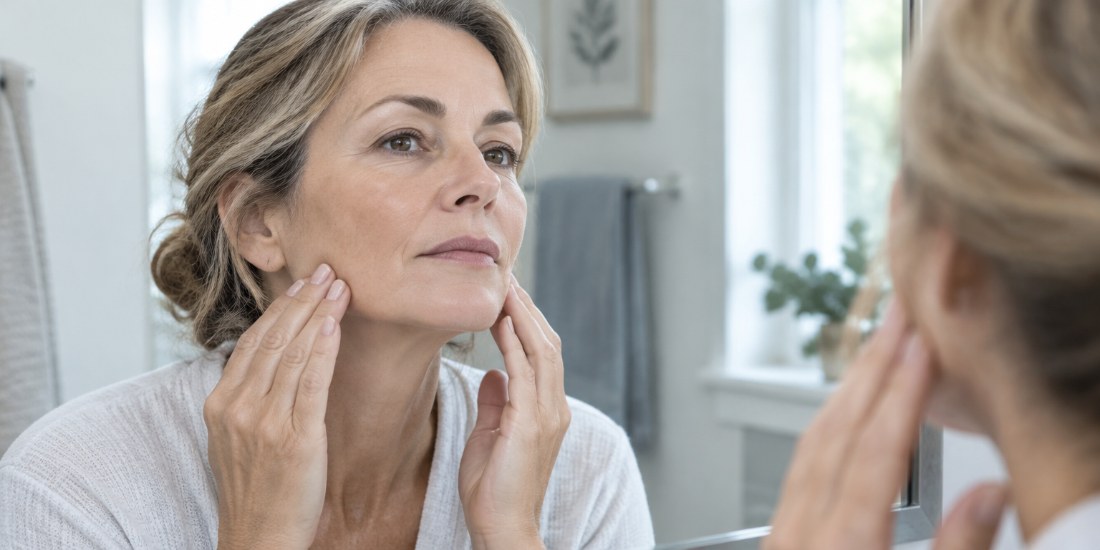
For many people, the first real sign of facial ageing is not a wrinkle. It is a softening along the jawline. Where there was once a clean, defined line from chin to ear, there is now a slight heaviness at the sides of the mouth, and the contour of the lower face starts to blur.
These are jowls, and they are one of the most common concerns we see in clinic. With party season approaching and more photographs than usual on the horizon, it is also one of the most frequent reasons patients come to see us in the autumn.
In this guide, we explain what causes jowls and the non-surgical treatments that can lift and redefine the jawline.
What are jowls?
Jowls are areas of loose skin and tissue that sit below the jawline, either side of the chin. They form when the tissues of the lower face begin to descend, disrupting the smooth line of the jaw.
Jowls can appear in your thirties, but they most commonly become noticeable in your forties and fifties.
What causes jowls?
Jowls are rarely caused by one single factor. They develop as several changes happen in the face at once.
Collagen and elastin decline. From our mid-twenties, the skin produces less collagen and elastin each year. Over time, skin becomes thinner, less firm and less able to resist gravity.
Fat pads shift. The face contains fat pads that give it shape. With age, some shrink while others descend. Fat that once sat high in the cheeks gradually moves downwards, adding weight to the lower face.
Ligaments loosen. The face is held in place by ligaments that anchor skin and tissue to the underlying bone. As these weaken, tissues are less firmly supported.
Bone changes. The jawbone and chin gradually lose volume with age, reducing the underlying framework the skin drapes over.
Lifestyle and genetics. Sun exposure, smoking, significant weight changes and genetics all influence how early and how prominently jowls appear.
Can jowls be treated without surgery?
Yes. For mild to moderate jowls, non-surgical treatments can produce a noticeable lift and a more defined jawline. The most effective approach usually combines treatments that tighten the skin with those that restore lost support.
For very significant sagging, surgery may still offer the most dramatic result, but many patients are pleasantly surprised by what can be achieved without it.
The ALTEON Korean Magic Lift
The ALTEON Korean Magic Lift is a new treatment at Hannah London, and it is particularly well suited to the jawline.
The ALTEON Hybrid Lifting Platform combines dual-wavelength laser with monopolar and bipolar radiofrequency. The laser first warms the skin, preparing it for the radiofrequency energy that follows. This energy reaches the deeper layers of tissue, where it stimulates collagen remodelling and helps to recontour the lower face.
Patients often notice a firmer, more lifted jawline straight after treatment, with further improvement over the following weeks as new collagen forms. There are no needles and no downtime, and sessions take around 30 to 45 minutes. Results can last up to two years.
HIFU
High intensity focused ultrasound, or HIFU, delivers focused ultrasound energy to the deep supportive layer beneath the skin, the same layer a surgeon tightens during a facelift. This triggers a gradual tightening and lifting effect that develops over two to three months.
HIFU is a well-established option for lower face laxity and can work well alongside other treatments.
Radiofrequency microneedling
Radiofrequency microneedling combines fine needles with radiofrequency energy to stimulate collagen and tighten the skin from within. It is particularly effective for improving skin texture and firmness at the same time, and can be a useful addition for patients whose skin quality is also a concern.
Dermal fillers for jawline definition
Where jowls are partly caused by loss of structure, carefully placed dermal filler can restore support. Filler along the jawline, the chin and the small hollow just in front of the jowl can straighten the contour and reduce the appearance of heaviness.
Restoring volume higher in the cheeks can also help, by providing lift that reduces downward pull on the lower face.
Which treatment is right for you?
Every face ages differently, which is why the best results come from a personalised plan. Many patients benefit from a combination approach, for example, the ALTEON Korean Magic Lift to tighten the skin, with filler to restore structure where it has been lost.
Your practitioner will assess your skin quality, the degree of laxity, your facial structure and your goals before recommending treatment.
Planning for the festive season
If you would like a sharper jawline by Christmas, timing is important. Treatments that stimulate collagen continue to improve for weeks after your appointment, so starting in October or November gives your results time to develop. Because the ALTEON Korean Magic Lift has no downtime, it fits easily around a busy diary.
Book a consultation
At Hannah London, our medical team, led by Dr Kaywaan Khan, specialises in natural-looking facial rejuvenation. We offer consultations at our Harley Street and Colindale clinics, where we will take time to understand your concerns and recommend the approach that suits you. If jowls are affecting your confidence, we can help you redefine your jawline without surgery.


